

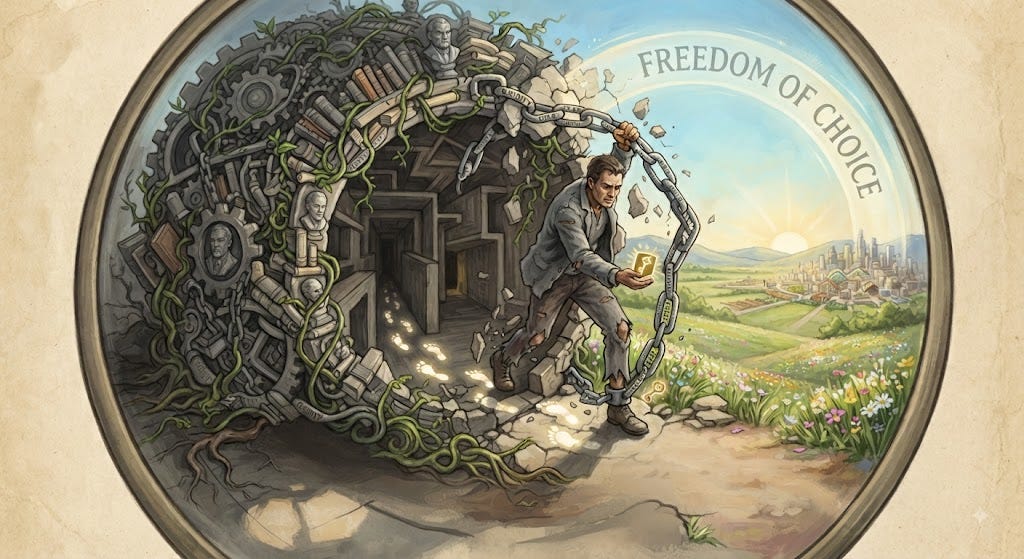
There are a great many fictions we carry about the nature of self. These fictions are distortions of how our embodied and embedded natural minds interact as a part of, but never apart from, the ongoing natural systems we engage with. Our stories of who and what we are matter because they set the stage for the actions we find possible, and therefore are inevitably placing limits on how our lives are lived. This isn’t to say that limits can be removed; we are still and always will be finite creatures, but it’s truly remarkable what we’re capable of doing when we see that all our stories are, while not fake, at least artificial and not always to be taken seriously.
The following are four articles that go into several of those distortions.
The first is the idea that there’s some authentic self you’re trying to display, when the reality is that you’re always you, and every social context will draw out variations of what that means. The important thing is to be aware of what’s being pulled on.

This next article is concerned with the distortion of a singular you arising from the disparate labels, identities, and social connections that you’re embedded within. It’s an issue of flexibility, and much like the trap of authenticity, attempting to find the singular you only gets you trapped when adversity finds you.

Speaking of flexibility, here we have the third in a series of articles about the psychological theory I operate from, what I often refer to as Relational-ACT. Once we acknowledge that who we are is a perspective embedded in a social context, behavior becomes a means of expressing what matters to us, no matter the situation. We may not always act exactly the same way in support of our values, but that doesn’t mean we have ceased to care about them.

Lastly, flexibility often leads to an increase in uncertainty and, therefore, stress, as behavior is seen more as a tool for expressing personal meaning instead of declarations of what must be from a position of authority. This is one reason why rigidity, dogmatism, and fundamentalist ideologies are so enticing: they are a bulwark against the complexity of reality by providing ready-made answers. Essentially, they’re the hotpockets of worldviews, requiring no skill to make and satisfying only if you don’t question what you’re putting in you.

Follow me on Threads or Instagram for more psychology, humor, and photography.
Schedule a Consultation
Reach out to schedule a mental health session regarding issues related to identity and decision-making, emotional regulation, difficulties in relationships, religious trauma, developing meaning/purpose, and the struggles of communication.
How You Can Support the Newsletter
This post was free to read for all. If you like what I’m doing with Humanity’s Values and want to support my work, there are several ways to do so.
Like and Restack: Click the buttons at the top or bottom of the page to boost the post’s visibility on Substack.
Share: Send the post to friends or share it on social media.
Dialogue: Expand the space for dialogue by engaging with others on the topics discussed here and help build the community.
Upgrade to Paid: A paid subscription gets you:
Full access to all new posts and the archive
Full access to all online classes
Full access to weekly presentations on various topics of psychology
Promotional discount on coaching/consultation services
The ability to post comments and engage in chat with the growing Humanity’s Values community
If you could do any of the above, I’d be very grateful. Readers like you help keep this newsletter going and growing.
Thanks!
David