



Claiming things are “toxic” is quite often a way to avoid acknowledging the functional purpose of the underlying behavior or space. A workplace may be “toxic” even as many of the protocols in place are there to address demands upon it. A relationship may be “toxic” even as needs are continuing to be met. Let’s be clear, this isn’t a declaration to stay within a situation that is destructive or dangerous to you. What we’re after is to see how toxicity is a descriptive after the fact. It is quite possible to appreciate the outcome of a thing even as the means by which it is generated is deemed awful. People often complain about the so-called toxic workplaces like Amazon and other tech firms, or lament the use of child labor, and yet are quite happy for that two-day delivery service and gleefully go down the consumerist hole that is Temu. I’ve worked with many couples over the years in relationships where the term “toxic” gets thrown around, and yet they don’t want to give up the niceties afforded by excessive work hours, even as they yell about the emotional neglect by the spouse who is engaged in providing them.
Much the same is going on when it comes to anger, and it’s supposed “toxicity” or, in softer language, being labeled as a “negative” emotion. We treat it like a radioactive spill in the living room of the psyche, something to be contained, neutralized, or scrubbed away as quickly as possible. We label anger a “secondary emotion,” a “character flaw,” or a “symptom of trauma.” The truth is: There is no such thing as toxic anger, and emotions are not in themselves positive or negative.
When we label an emotion as “toxic,” we aren’t just describing a feeling; we are engaging in a narrative act. We are telling ourselves a story that says certain parts of our human experience are inherently broken. I often write and present about how narratives direct the behavioral expressions of our emotional reactions. If a certain story is that your anger is a “toxin,” your response will be an avoidance strategy of suppression, shame, and fear. Further, since feelings are not anything that you had any control over in their initial emergence, labeling one or another toxic or negative is to declare that some intrinsic part of yourself is such.
The challenge here is to look through the lenses of George A. Kelly’s Psychological Constructivist Theory (PCT) and Acceptance and Commitment Therapy (ACT), and by doing so, you can find a far more empowering reality.
The Scientist in the Storm: George A. Kelly’s View
George A. Kelly famously suggested that every human being is, in their own way, a scientist. We are constantly making hypotheses in the form of psychological constructs, organizing our behavior as instruments of testing our understanding of the world we believe we exist in. We don’t just “have” personalities; we build “construct systems,” internal models of how the world works, so we can predict and navigate our lives through the behavior we believe is available for us to engage in. From this perspective, an emotion isn’t a “thing” that happens to you; it’s a signal about how well your “experiments” in living are going.
In Kelly’s Personal Construct Psychology (PCP), anger is defined as the effort to maintain conditions that we believe “ought to exist.” Think about that. Anger is the sound of your internal narrative system insisting on its own validity. For many, confirmation bias is something to avoid, but psychologically, the confirmation heuristic is a cognitive means of establishing continuity in one’s projections. When you get angry because someone lied to you, your “scientist” is observing data that contradicts your theory that “people I trust should be honest.” Your anger is a vigorous attempt to keep that theory intact. It is a protective, self-validating response.
Accepting Your Anger

An introduction to my online class on the nature of anger and how to change your relationship to it.
The problem arises not from the anger itself, but from what Kelly called hostility. In the PCP framework, hostility is the “continued effort to extort validational evidence in favor of a type of social prediction which has already proved itself a failure.” Anger says, “This shouldn’t be happening!” Hostility says, “I will break you until you admit I’m right, even though the evidence shows I’m wrong.” In both reactions, we are responding to a perceived threat.
Threat was defined by Kelly as an awareness that a comprehensive change was imminent in your core constructs and, therefore, in your conception of yourself. In the broadest sense, threat can be induced when we perceive any plausible alternative to our core constructs. A comprehensive change in one’s core constructs is what occurs during an “identity crisis,” when one’s conception of oneself is shaken and needs to be re-construed. (David Lester, “Emotions in Personal Construct Theory”)
When we call anger “toxic,” we are usually looking at the hostile behaviors people use to avoid the pain of being wrong. But by labeling the feeling as the problem, we miss the data the feeling is providing. Anger is a signal that your construct system is under pressure, that how you desire the world to be is under threat, or has already been thwarted. Anger is, rather than something to avoid, an invitation to look at your “theories” about the world and decide if they need an update. It isn’t a poison; it’s a challenge to review how you see yourself and the world within which you interact.
The Trap of “Toxic” Labels: An ACT Perspective
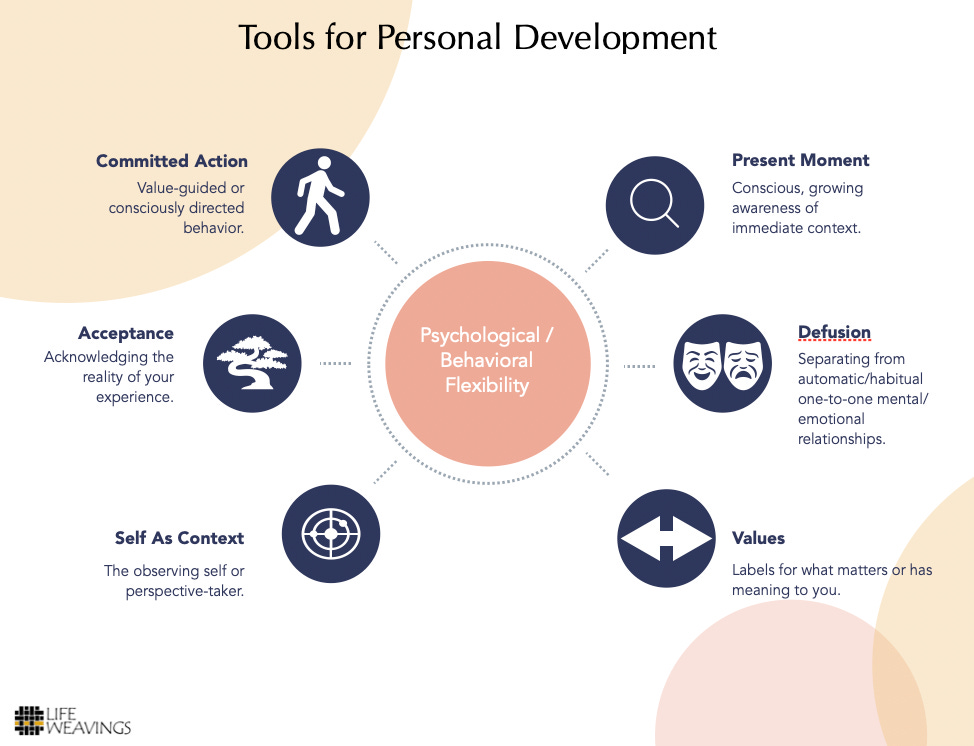
This is where the principles and practice of Acceptance and Commitment Therapy (ACT) provide a necessary bridge to healthier living. In ACT, we talk about cognitive fusion, getting so caught up in our thoughts and feelings that we think they are the literal truth. When you feel anger and experience it as an expression of who you are, your mind starts spinning a story: “I am an angry person,” or “This person is destroying me.” This is where emotions are eminently reasonable, and the dichotomy of reason and emotion is false (a point Kelly was often at pains to point out). The emotion is a recognition, a declaration, that the construct through which one interacts within the world is under threat, that they are under threat. Reason and emotion are simply two ways of expressing the symbiosis of personal experience.
However, the seamlessness with which our experience seems to be derived from us leads to that fusion and a reduction in nuanced appreciation for varied ways of looking at a situation. By adding the label “toxic” to that anger, you have created a second layer of fusion. Now you aren’t just angry; you are “toxically angry.” You’ve turned a temporary biological and psychological state into a permanent, shameful identity.
ACT teaches us that no internal experience is inherently “bad” or “good.” Instead, we ask: Is this workable? The question is about function. Does acting on this feeling move me toward the person I want to be and in the service of the values I hold dear?
When we stop fighting the anger—when we practice acceptance—we aren’t saying the anger is pleasant. We are simply acknowledging that it is there. By making room for the anger, by defusing from seeing it as an identity, we stop the seemingly inevitable process of behavior turning destructive. The toxicity isn’t in the anger; it’s in the struggle against the anger as we lose sight of what it’s pointing us to, and get hooked into making the world “right” through any means necessary. Consider how the more you try to push a beach ball under the water, the more violently it pops up and hits you in the face.
Anger as a Value-Pointer
If you look closely at your anger through the lens of constructs under threat, you’ll find that it is almost always pointing toward something you value. You don’t get angry about things you don’t care about.
If you are angry about an injustice at work, it’s because you value fairness. If you are angry at a partner’s neglect, it’s because you value connection and reliability. Anger is the “bodyguard” or “shield” of your values. When we pathologize it as “toxic,” we end up pathologizing the very values the anger is trying to protect.
In my class on Accepting Your Anger, I challenge people to stop asking “How do I stop being angry?” and start asking “What is this anger protecting?” When you identify the value beneath the intensity, you gain the self-empowerment to flexibly choose your response. You can move from reaction (hostility) to action (living your values).
Deconstructing the “Fragile” Narrative
One of the most damaging trends in modern therapy is the suggestion that we are fragile, that “negative” emotions like anger are trauma-induced glitches that require constant “regulation” or “healing.” This narrative makes us victims of our own biology.
Psychological Flexibility Supports Humility and An Appreciation for the Influence of Time

Flexibility reminds us of possibility, of options, of taking different perspectives and recognizing that while habits can help save time, the road less traveled can sometimes provide greater solutions.
Constructivism tells us we are not fragile; we are active. We are the authors of our own meanings. If you feel anger, it isn’t because you are “broken” or “dysregulated.” It’s because you are a meaning-making machine within a world that doesn’t always fit your blueprints.
By refusing the label of “toxic anger,” you reclaim your agency. You recognize that you have the capacity to hold intense, difficult feelings without being consumed by them. You learn that you can be angry and kind; angry and effective; angry and centered in your values.
The Way Forward
So, how do we live with an emotion that the world insists is dangerous?
Notice the Narrative: The next time anger rises, notice the labels your mind wants to attach to it. Is it calling the anger “toxic”? Is it telling you that you’re “losing control”? Recognize these as stories, not facts.
Validate the Construct: Ask yourself: What “ought to be” happening right now that isn’t? What theory about the world is being challenged? (e.g., “I expected to be respected, and I’m not.”)
Check for Hostility: Are you trying to “extort evidence” to prove you’re right, even if the situation has changed? Are you trying to force reality to fit your old construct? This is where the damage happens.
Pivot to Values: If this anger is a bodyguard, what is it guarding? Fairness? Safety? Excellence? Once you find the value, ask: “What is the most workable way to honor this value right now?”
Anger is part of the “Humanity” in Humanity’s Values. It is a fierce, vital, and necessary part of the human experience. It is the fuel for change, the signal of injustice, and the guardian of our boundaries. It isn’t a poison, and it isn’t a disease.
It’s time we stopped trying to “cure” our anger and started learning to listen to it. You aren’t toxic. You’re simply human, and your anger is proof that you still believe you have something worth fighting for. Reach out and embrace the value.