


In the recent article “The Modern World Hasn’t Left Our Evolutionary Past Behind,” I explored the idea that, rather than our species, and therefore individual people, being in some way outside or at odds with the modern technological world, we are still very much capable of navigating the world we’re in. As a species we have not supplanted evolution for the supposed glories of our rational minds, but remain deeply embedded in the mechanisms of our biological impulses that drive our behavior. Our stories about ourselves may be more complicated than the images on the walls of caves, but the process of making up those stories is still inviolably connected to the natural biological reality in which we are embodied and embedded.
This notion of being somehow at odds with our environment is, I contend, very much connected to what is referred to as “therapy culture,” the notion that we are intrinsically fragile creatures in need of professional care in the face of a world that is against our well-being. Quite often these days, at least in certain social circles, this takes the form of declarations against capitalism, where every bad version of human behavior is laid at the feet of this seeming fourth force of physics in the universe that serves as a similarly destructive construct for secular liberals as “sin” does for fundamentalist Christians. Poking at these criticisms isn’t the point here (for an excellent attempt, check out this article), only using it as an example of how often people look at the modern world and find themselves seemingly cut-off or set-aside from it.
As Erich Fromm noted in “Escape from Freedom,”:
“The physiologically conditioned needs are not the only imperative part of man’s nature. There is another part just as compelling, one which is not rooted in bodily processes but in the very essence of the human mode and practice of life: the need to be related to the world outside oneself, the need to avoid aloneness. To feel completely alone and isolated leads to mental disintegration just as physical starvation leads to death.” Fromm, Erich. Escape from Freedom (p. 17).
The first part echoes much of what people say now, believing themselves cut off from the world through technological abdication of their needs. Yet, Fromm immediately notes the solution that still remains for all of us, the need to be related to the world outside oneself, a need and biological drive that has not left us.
Instead of looking at the world as somehow contrary to us, I offered a set of principles of adaptation to reframe our situation.
Principles of Evolutionary Adaptation
Our evolution in the Environment of Evolutionary Adaptiveness (EEA) equipped us not only with specific mechanisms but also with the flexibility to address novel situations.
Behavior serves many purposes, some proximal and others long-term, with variable consequences.
Behavior is fundamentally about addressing functional concerns in specific contexts, which are constantly changing.
Technological development emphasizes certain behavioral patterns only by modifying environmental boundaries, not by undermining alternatives.
Foundational to these principles is how flexibility, rather than simply a behavioral descriptive, is a psychological imperative built in by our evolutionary past. This is why, within the modality of Acceptance and Commitment Therapy, flexibility is at the center of the six processes that make up the practice.
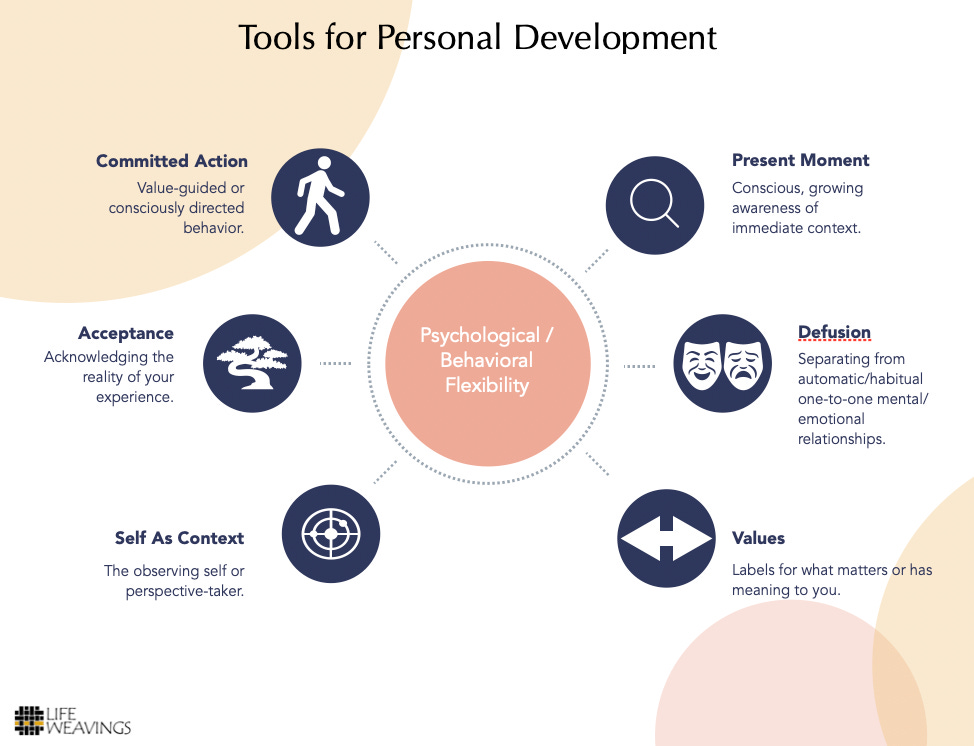
As with ACT, so then the general question of therapy in general, where the central issue to be concerned with is that of flexibility or, to use an older term, resilience. While resilience can be promoted badly, it’s really not at all a matter of yelling “stop it!”, however funny Bob Newhart makes it sound.
Flexibility reminds us of possibility, of options, of taking different perspectives and recognizing that while habits can help save time, the road less traveled can sometimes provide greater solutions. A reminder of principle 3 from above, where behavior exists to address functional concerns within changing contexts. Too often we get stuck in saying we’re seeking clarity, but truly we’re just looking for confirmation. This is where I often hear declarations from clients of wanting someone else to “understand,” when really they just want agreement. The changing context involves where each person is coming from, including the variations in what values they find important, and how they seek to support them through behavior.
Holding thoughts lightly, an ACT principle, works quite well here, where the active appreciation for changing circumstances keeps us from being blindsided by consequences we never believed possible. The felt sense of being overwhelmed by life is quite often an issue of feeling that behavioral involvement is always a matter of necessity, rather than choice. Parents are an easy example here, with the “need” involving having their children being a part of every activity and providing them every new tech toy and fancy piece of apparel, despite the consequence of a destructive reduction to time and finances.
It’s as if by calling something a “need” people believe that the universe should remove us from the law of cause and effect. Thankfully, reality is not that accommodating.
A focus on flexibility is two-fold: the pursuit of what is possible, and a recognition of one’s limits. In a word: humility. Humility is a character trait that admits the universe is not at our beck and call, and how our capacity to declare something a need or a right doesn’t make them such. Humility reminds us that we live in a reality of interconnected relationships, competing desires, and limited resources, where our expectations are a declaration of our desired outcomes, but are not dictates for people to follow.
Much of mental health therapy, and living a mentally healthy life in general, is found in providing a space to hold back from making decisions that will only exacerbate the very problems that brought the person in for help in the first place. By bringing attention to flexibility, and exploring humility, we allow the inexorable march of time to remind us that just because a feeling is valid, doesn’t make it correct, and just because we think we’re right, doesn’t mean there isn’t a great deal more to learn.