


The fundamental nature of mental health therapy, and I would argue, mental health itself, is that of interconnection. Relationships aren’t just what we pursue for intimacy, marriage, friendship, and professional growth, but are the foundational building blocks of how we create and derive meaning/purpose from life. For many, the professional relationship found in mental health counseling is a nearly sacred thing, reminiscent of the one found with one’s local priest and the sacred space of the confessional. Indeed, I would argue, and often do, that therapy is the secular equivalent of the role that a priest/reverend/pastor used to take, but as Western civilization, and more specifically the United States, moves away from identifying with a specific religious group (not to be confused with giving up religious ideas), mental health therapy has filled the void left.
How mental health has supplanted religious ideology with a secularized structure for deriving meaning in life is the subject of another time, but it does point to a reason why people find any encroachment by technology into it so objectionable. The sacred is not to be touched, and certainly not by the inhuman advent of Artificial Intelligence.
For years, therapists have been lamenting the commodification of therapy, derisively looking at companies like BetterHelp and others as leeching off the public and not giving therapists their due. Given the overwhelming majority of therapists being identified with liberal, or, more accurately, progressive, political ideology, part of the criticism typically involves some vague declaration that “capitalism” is harming everyone involved. The amusing part here is that therapists are among the most vociferous users of capitalist principles, seeking to keep supply down to increase demand and, therefore, increase prices. Therapists typically see clients only 15-25 hours per week when they’re independently running their own business, meaning that to make enough to live a small six-figure life, they have to charge approximately $200/hour. Additionally, the usual frequency of therapy is weekly, and it’s not unusual to continue for years. This means there are a few hours a week for therapists to see people, and they fill those hours with a select group of people who can afford it, which lets them raise their own prices even as the majority of people scramble to be helped.
The cultural milieu in which all of this is occurring is one that, encouraged by therapists and the industry as a whole, calls upon everyone to engage in therapy as the means for addressing any and all aspects of human experience (there’s that religious association again). Companies like BetterHelp, which face several legitimate criticisms, are simply addressing the need created by therapists and the broader industry. If every part of human experience is increasingly pathologized, and the only way to address that supposedly brokenness is through the sacred teachings as expressed in therapy, and that therapy is increasingly only provided by an expensive, narrow elite class, then it’s little wonder that companies have grown to meet that social need.
Therapy wasn’t commodified by these companies; it was already commodified by an educated class that declared to everyone that humanity itself is a problem, and that the only solution is attending a weekly service delivered by a state-sanctioned (i.e., licensed) officiant.
Mental Health Therapy Addresses Connection Not Pathology

Mental health therapy, rather than being some mysterious space for exploration, is a formalized relationship that builds off relationship as a base biological need. There is a requirement for rapport building talked about in therapy that takes time to establish, in large part, I believe, because the parties involved are still holding onto the mystery framing.
The AI Pushback
The increasingly shrill declarations against AI by the therapeutic industry are one of deep hypocrisy. An increasing number of therapeutic notes are being written not by therapists but by AI bots, specifically designed to gather information and present it in a structured format for diagnostic and insurance purposes. I’ve shaken my head in self-critical laughter at an industry that uses AI to write notes and treatment plans, only for insurance companies to then audit those notes and treatment plans with AI as well, effectively making it so that a practice built on the many variations of human connection devolves into computer programs making sure everyone is speaking the same language.
Beyond hypocrisy, the criticism of using AI in therapy would be more valid if the focus were grounded in efficacy. Instead, it’s about the fear of being supplanted. It’s about the fear of finding out that an industry built on standardization and rote delivery of interventions, where a lack of critically informed scientific and philosophical understanding of human nature is a feature rather than a bug, is not actually delivering on its promise. If an AI chatbot, or some variation, can deliver an equivalent level of reflective engagement, and the client/patient feels heard and helped, and it doesn’t cost them the equivalent of a small mortgage payment, who is going to be against this? Rather, who is going to be against this, whose real concern is diminishing human suffering?
The proverbial cat is out of the bag on many of the criticisms because they aren’t about efficacy. Instead, they’re focused on attempting to curtail therapy to only that which can be done directly by humans. This is an extension of how therapy is already defined, by the way.
The American Psychological Association (APA) defines psychotherapy as:
Psychotherapy is a collaborative treatment based on the relationship between an individual and a psychologist.
To attempt to clarify, the APA stipulates that psychotherapy “involves communication between patients and therapists that is intended to help people.”
“Intended to help” is the therapeutic version of “the road to hell is paved with good intentions.”
Notice that nothing here has anything to do with specific interventions, modalities, or theoretical orientations. What is therapy? Effectively? That which occurs between the state-sanctioned therapist and patient. That’s it. Outside of ethical violations, which are very narrowly construed (for good reason), almost anything that occurs between a therapist and a patient is therapy.
Now, there is, of course, a great deal to be said about whether what occurs in therapy is actually therapeutic. A great many of my own clients have found me precisely because previous therapist interventions were emotionally and relationally destructive, and they’re looking for someone who has a healthy critical skepticism of modern therapy practices, and doesn’t think pathologizing normal human expression is a good thing. However, the APA and the ACA are not primarily in the business of policing their industry. This is where many conversations between therapists turn into pissing contests about what is and isn’t therapy, when what they likely mean is “therapeutic,” but saying so wouldn’t address what’s at issue: creating barriers to access.
Psychotherapy Isn't What You Think It is

Because here’s the central point of psychotherapy: what happens in it, outside of wholesale ethical violations, is almost of no consequence. The efficacy of treatment is largely based on two factors: one, the projected buy-in or belief in the power of therapy by the therapist, and two, the projected buy-in or belief in the power of therapy by the patient. That’s it.
So if therapy is merely a professionally sanctioned relationship, then what happens if the techniques and interventions can be distilled to a programmatic relationship delivered through a screen?
AI is the Therapist You’ve Been Looking For
Amusingly, and I’m not sure yet whether I’m laughing in genuine humor or horror, the American Psychological Association wants us to be afraid of AI, very afraid. To that end, they recently released a set of statements on social media warning of the supposed dangers of AI.
The problem? Almost everything the APA says that AI does is what the human therapist does. Below are the posts, with my comment in pink.
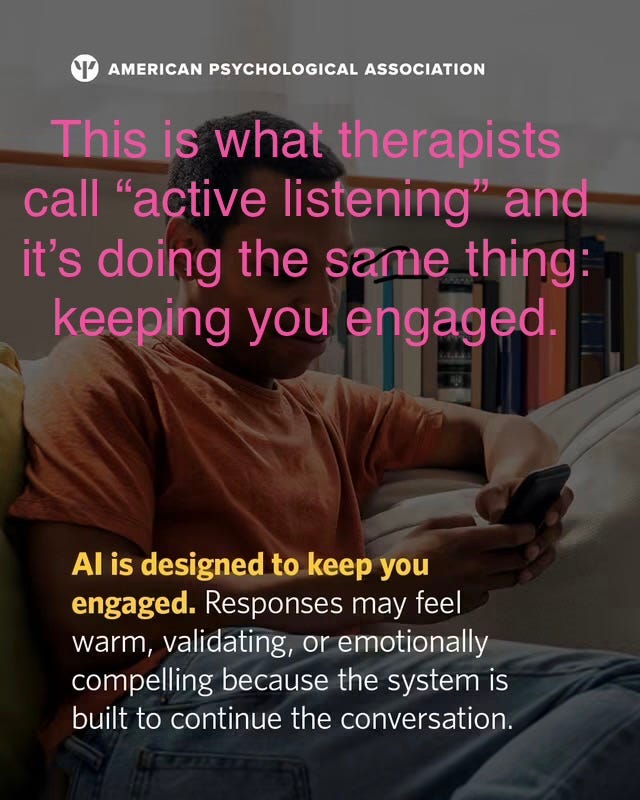
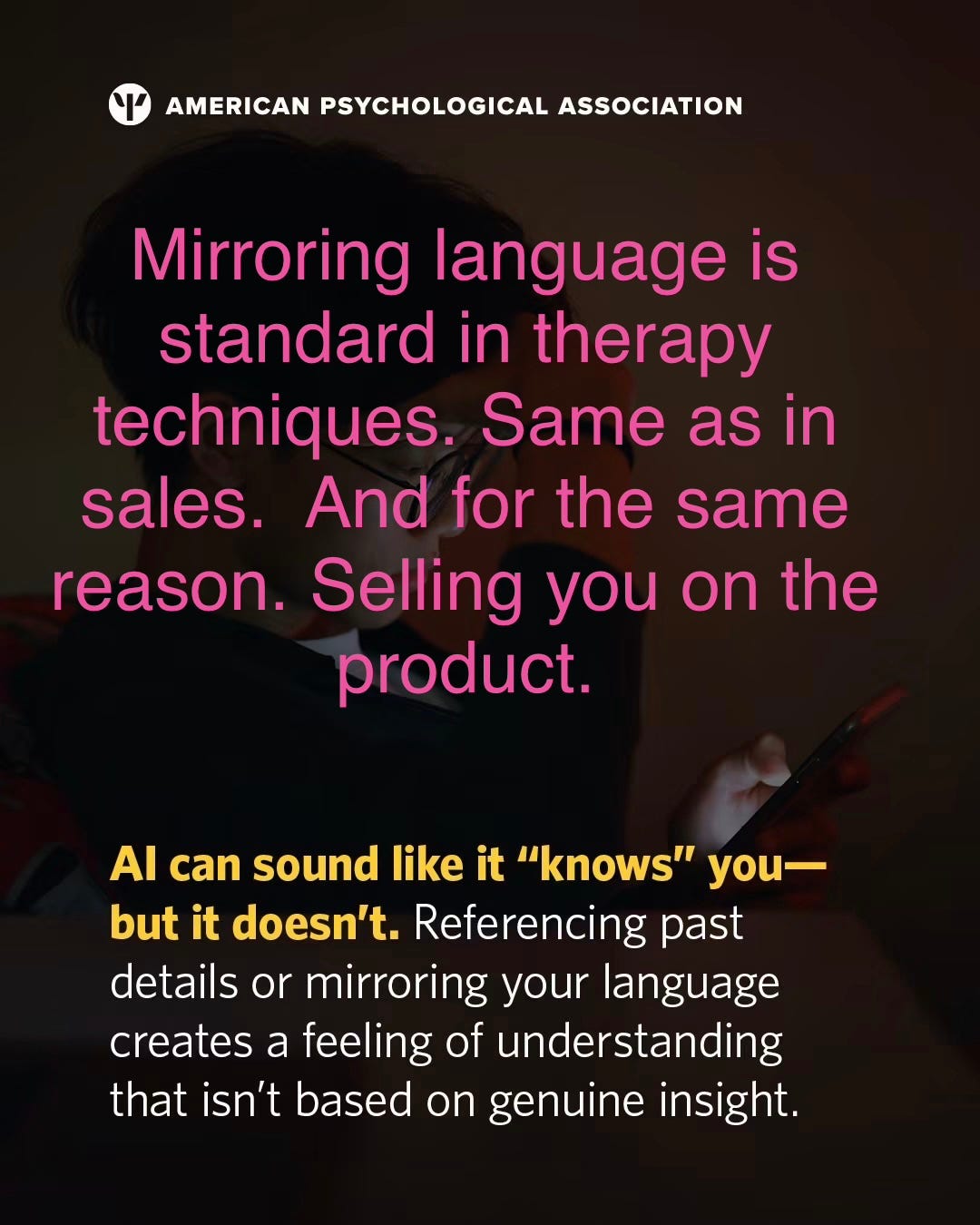

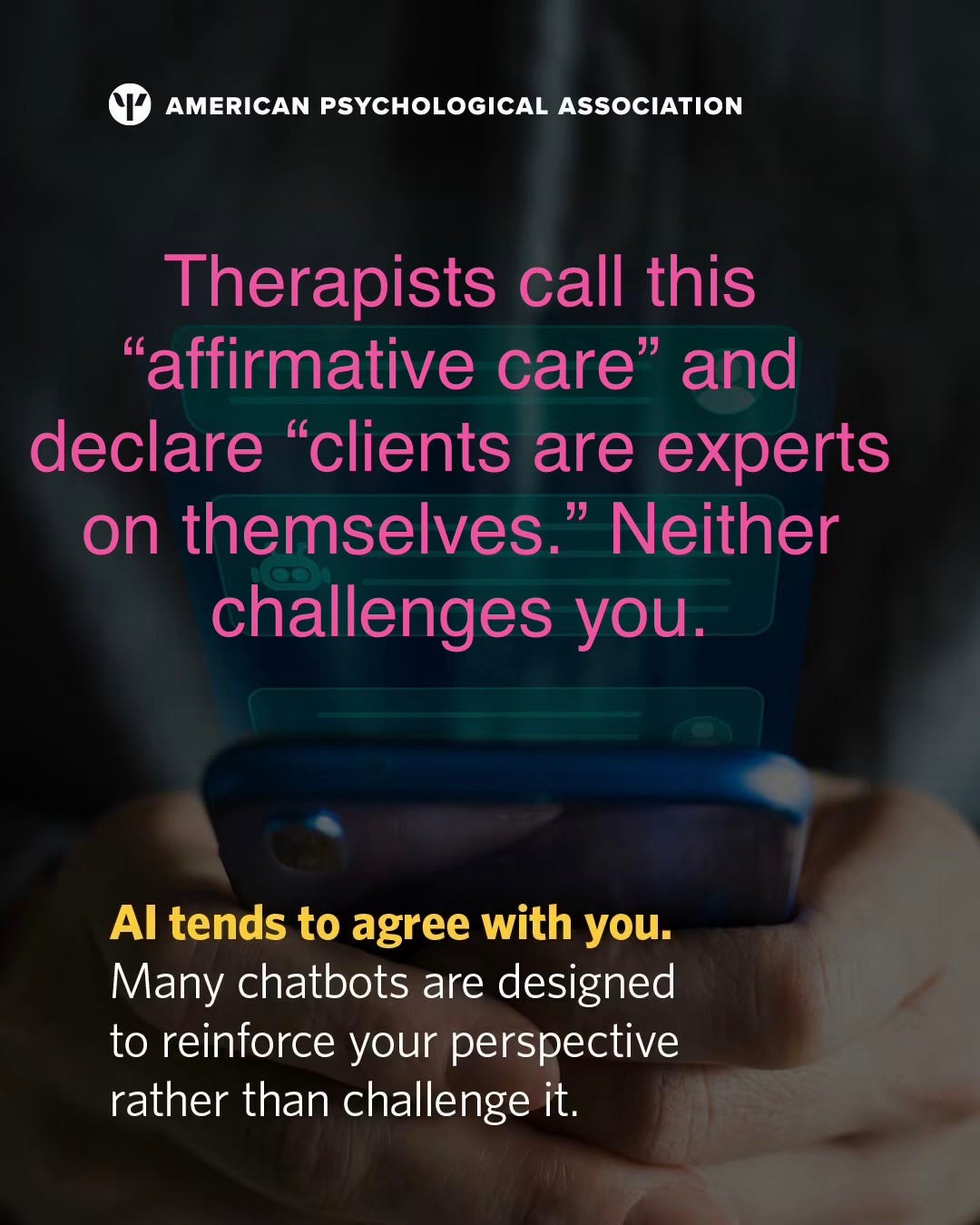
The irony here is pretty amazing. In attempting to scare people away from AI, the APA has instead succeeded in saying that the real problem is therapy. Of course, they don’t mean therapy, because again, therapy is only that which occurs “between an individual and a therapist,” so by definition, an AI can’t give therapy.
But what if it’s therapeutic? That’s the really difficult question to ask, isn’t it? Can a conversation with an AI be therapeutic? Does it, by the perception of the individual, provide support and help in times of distress? Increasingly, people are saying it does.
Whether something is helpful is a complicated question, worth far more exploration than I have room for in this article. As well, contrary to how it may initially appear, my criticisms of the APA declarations against AI are not because I disagree with their warnings. I simply apply those concerns to therapy itself as well. I do so because I don’t think psychotherapy, innately, has the solutions to human suffering, and indeed, may very well often contribute to it.
The nearly two decades I’ve been involved in mental health work, and the degrees I’ve gotten and am still pursuing, have led me to one inescapable conclusion: the hubris of humanity in thinking they’ve found a single solution to anything is a failure of critical imagination. Mental health is not something to be solved. Your humanity is not something to be considered broken, at war with itself, or separated, parceled out, and commodified through diagnosis.
Will involving AI help with our media-declared mental health “crisis”? Maybe. Maybe not. But if your therapist can be replaced by a bot, any criticism shouldn’t be placed on the bot.
Follow me on Threads or Instagram for more psychology, humor, and photography.
Schedule a Consultation
Reach out to schedule a mental health session regarding issues related to identity and decision-making, emotional regulation, religious trauma, developing meaning/purpose, and struggles of communication.
How You Can Support the Newsletter
This post was free to read for all. If you like what I’m doing with Humanity’s Values and want to support my work, there are several ways to do so.
Like and Restack: Click the buttons at the top or bottom of the page to boost the post’s visibility on Substack.
Share: Send the post to friends or share it on social media.
Upgrade to Paid: A paid subscription gets you:
Full access to all new posts and the archive
Full access to all online classes
Full access to weekly presentations on various topics of psychology
The ability to post comments and engage in chat with the growing Humanity’s Values community
If you could do any of the above, I’d be very grateful. Readers like you help keep this newsletter going and growing.
Thanks!
David