

In one of the many philosophically laden scenes in the “Matrix” movies, the character Neo is visiting the Oracle to determine whether he has what it takes to be a digital savior for all the mech-using humans currently living in what can only be described as a Titan-sized plumber’s paradise. Seriously, I love sci-fi movies, but the extent of the infrastructure often built in a ridiculously short time truly boggles the mind. No other movie (to my immediate recollection) comes close to “The Minority Report,” where, somehow, vast highways for single-person pod-cars have been built in less than a few decades from the current timeline. I understand that writers lean more toward fiction than science, and maybe putting in ridiculously large infrastructure projects is meant to inspire, but every time I see something like it on screen, I can’t help but laugh at how the show has gone from sci-fi to fantasy.
Back to the Oracle, though I promise the sojourn into a pet peeve concerning sci-fi shows is relevant (mostly), Neo is confronted with the Delphic declaration of “Know Thyself.” Carved into stone at the entrance to Apollo’s temple in Delphi, Greece, the statement can serve as a window into the degree of hubris each civilizational period has contained over the last couple of millennia. To what degree can anyone know themselves? Better, is there a singular self to know? And this will really bake your noodle: is there even a self to know at all?
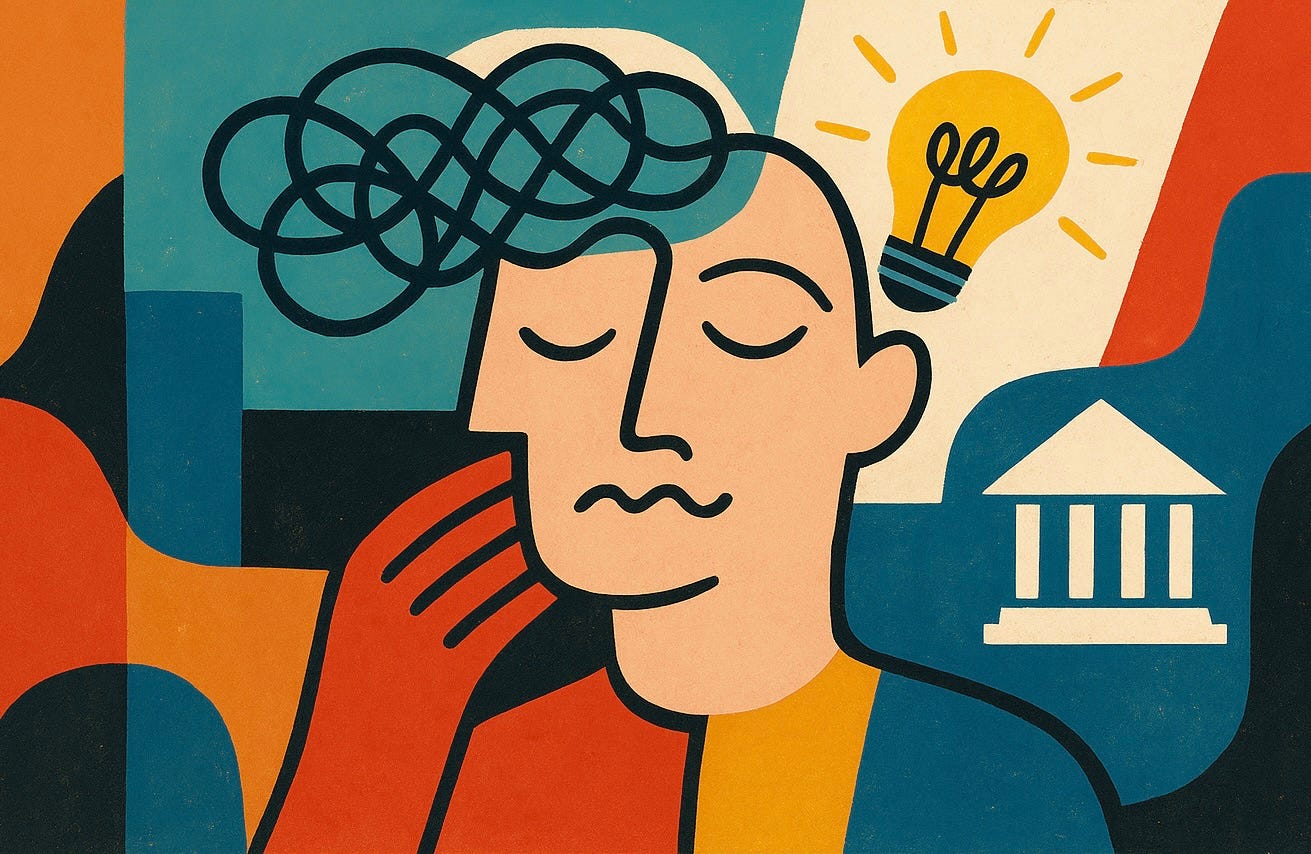
In Francis Fukuyama’s book “Identity,” he notes a shift in contemporary thinking about the nature of the self, in which the distinction between inner and outer identity has led to a preoccupation with and ascendancy of the so-called inner or authentic self, beyond outward behavior and appearance.
“The foundations of identity were laid with the perception of a disjunction between one’s inside and one’s outside. Individuals come to believe that they have a true or authentic identity hiding within themselves that is somehow at odds with the role they are assigned by their surrounding society. The modern concept of identity places a supreme value on authenticity, on the validation of that inner being that is not being allowed to express itself. ” From: Fukuyama, Francis. “Identity.”
One of the results of this ascendency, as Fukuyama notes as well, is that previously the outer world served as a corrective to inner foolishness. We could imagine any number of things, but in their application, we would have to deal with the rest of reality — since we are not separate from it — which didn’t always follow our desires. Today, that relationship has flipped, such that the inner world has become the repository of truth — what is referred to as positional epistemology or “standpoint theory” — and if the outer world doesn’t conform, then it is at fault.
If you’ve heard the phrase “lived experience,” this is standpoint theory applied to individual psychology. If you’ve heard other phrases like “my truth,” or a preoccupation with supporting statements with “I feel,” this is positional epistemology at work. It is also the predominant tool for much of what passes for mental health therapy these days, alluded to in the declarations of finding the “real you” or “authentic self,” and in the advertising language of “you’re the expert of your own life.”
As one therapist expressed themselves:

This mentality is why people look for therapists who “look like me,” though the end result is that they are also looking for therapists who “think like me” and, most importantly, “validate me.” Carried to the logical — to many a bad word — conclusion, the standard for knowledge being put forward here makes it impossible for anyone to know anyone else. If a therapist has to “examine their own story” (as if there is only one), including delving into “all they had to hide of themselves” (another huge assumption, and if something is known it isn’t hidden, and if it’s hidden then the person doesn’t know it anyway), and only by doing this will they be able to “get” another person, then not only is the work never finished, if the client hasn’t done the same process, they won’t “get” the therapist either.
Note that in this description, the client doesn’t have to do any work, as it is assumed they already know themselves perfectly. They are, as it is often phrased, “experts” of themselves. Making this more confusing is that the statement about the therapist not understanding what meaning the client’s story has for them points to such meaning residing at an “unconscious" level. This means that the meaning is not accessible to the client either, despite later being assured that “you are the only one who knows about you.”
Some may believe that I cherry-picked a singular comment to make my point, and I assure you, I did not. This is standard fare for therapeutic discourse. The inner world and the subjective have always been part of clinical work, which is why behaviorism sought to codify interventions and outcomes, moving away from the imaginative and non-falsifiable conjectures of psychoanalytic theory. That subjective report is still a part of psychological research is inevitable, since the current state of technology provides no way of mind-reading. The difficulties of subjective reporting, namely that people lie to themselves and to others, are inevitably prone to motivated reasoning, and are often answering different questions than what are actually asked, are all taken into consideration within research. That’s why you won’t, or rather you should never, see a definitive claim from science, particularly the social sciences, and instead every claim is probabilistically understood within narrow parameters.
Unfortunately, the incentives for elevating the subjective are strong, particularly when there’s a parallel push from the industry and elements of society as a whole to avoid discomfort, with validation replacing challenge. This is where you find the self-diagnosis movement in social media postings and increasingly from therapists as well. Here’s another statement from a therapist:

Again, I truly wish this were a minority opinion. Beyond the utter and complete lack of even an attempt at objectivity, this statement is coming from a group that mocks and belittles people from a different ideological bent, relying on their inner certainty when it comes to politically charged issues like COVID and vaccines. The lack of consistency isn’t just a feature of this thinking; it’s a central point. As is the case with so many statements of belief, they are not about articulating how the world works so much as signaling to others of like mind that they belong.

What is lost in all of this is any sense of humility, of a recognition that our biological evolution has only ever been focused on providing good-enough strategies for dealing with environmental constraints. The brain is no different than the rest of the body, despite how many people like to think the mind is somehow different, whether it be seen as the repository of the imago dei in Christian mythology, as possessing the power of context-free free will, or as the location of a singular transcendent self.
That’s something I would be inclined to yell from the rooftops, in the sense that one big barrier to achieving anything in the direction of self-knowledge is hubris, thinking that we do know, often confusing our confidence in our opinions with thinking that confidence is an indication of my degree of correctness. We feel sure, and take that surety itself to be evidence of the truth of what we think. (interview with Mitchell S. Green)
We are a species for which consciousness gives us the illusion of knowing about ourselves more than we actually do. Our rich and varied so-called “inner world” provides the enticements of certainty and emotional weight that Cypher from “The Matrix” is more than willing to step back into, despite doing so meaning he has to kill his friends.
Do any of you truly think you’ve stepped away from biology to not have this be an influence? We as a species have killed one another over religious mythology and imaginary lines drawn on maps. We get angry with people for behavior we imagine they’re doing, and judge ourselves for statements we imagine others are saying. We pretend with one another that the rules of driving are somehow intrinsic to the practice, and curb our behavior because of imagined social judgment about ignoring streetlights, even when nobody is coming from the other direction. We flip switches without — at least most of us — knowing how electricity and electrical engineering work, and push buttons to start cars without knowing how internal combustion engines and the electronics that are now ubiquitous function. We see a lack where there isn’t one and threats where there aren’t any. We mishear conversations all the time, and our memories are reconstructions rather than recollections.
Yet despite all this and so many other examples besides, when it comes to our day-to-day mental declarations, we go full speed ahead, heavily laden with hubris. And now we return to my amusing, to me, criticism of sci-fi movies, and the predilection they have for showcasing a world where the development of social cohesion to make massive infrastructure changes somehow overcame all the restrictions we know exist.
Dipping the toe into fantasy is a sign of that hubris in action, but we enjoy it because it provides hope for a future we’d like to step into. I can appreciate that desire. I’m hardly immune to it. Let’s just try not to mistake the desire for an outcome for what’s actually in front of us, and then not see all the work required to get to even an approximation of it. That’s true of community projects and our personal growth.
Follow me on Threads or Instagram for more psychology, humor, and photography.
Schedule a Session
Reach out to schedule a mental health session regarding issues related to existential difficulties, religious trauma, developing meaning/purpose, and the struggles of communication.
How You Can Support the Newsletter
This post was free to read for all. If you like what I’m doing with The Humanity’s Values Newsletter and want to support my work, there are several ways you can do it.
Like and Restack: Click the buttons at the top or bottom of the page to boost the post’s visibility on Substack.
Share: Send the post to friends or share it on social media.
Upgrade to Paid: A paid subscription gets you:
Full access to all new posts and the archive
Full access to all online classes on psychology and religious trauma
Full access to exclusive content such as weekly presentations on various topics of psychology and religion
The ability to post comments and engage in chat with the growing Humanity’s Values Newsletter community
If you could do any of the above, I’d be very grateful. Readers like you help keep this newsletter going and growing.
Thanks!
David