

Although there are no souls or nonphysical minds, no immutable selves, although there is no such thing as free will, there are still, at the end of the day, persons. What is a person? A conscious social animal that deliberates, reasons, and chooses, that is possessed of an evolving or continuous—but not a permanent or immutable—identity, and that seeks to live morally and meaningfully.
There is a pervasive problem: even in social circles where biological evolution is an established scientific truth, few want to apply it to any area above the neck. It is as if nature took a holiday when it came to the brain or mind and said to itself, sorry, that’s too complicated, I’ll leave it alone and let the ephemeral take over. Within Western Christianity, this often manifests in references concerning the imago dei, or “image of god” as it alludes to the mind or seat of the soul or intellect, where we may receive all new bodies but retain our soul/mind. Within secular communities, typically more liberal politically, this avoidance of the brain/mind as operating under evolutionary constraints like the rest of the body, manifests in variations of declaring that social constructionism, the malleability of the person through social means, and, particuarly in more recent days, the elevation of individual thought as lived experience capable of transcending human bias by virtue of possessing one or another immutable characteristic considered sacred through pereceived oppression. Regardless of the source for one’s capacity to transcend the immediately material, soul or personal declaration, the result is an impressively naive abnegation of interpersonal influences and a tendency to ignore the innate biased qualities of cognition in favor of identity-based righteousness.
“We are not like them” is truly the mentality that unites everyone.
Except, despite the desire to remove oneself from the natural world in ways that support one’s desired social exclusionary conclusions, none have actually done so. We are all, every one of us, embodied and embedded in natural systems that we are incapable of seeing our way out of. Case in point: attempt to choose the next thought/emotion you have. Seriously. Try it. You are now having the thought of choosing the next thought. Right. Did you choose that thought though? At what point do you stop and humbly acknowledge that the thoughts/emotions providing the substance of what you consider to be your experience are just appearing seemingly from nowhere, and certainly not without any conscious deliberation? How far will you go to deny this fundamental aspect of human experience, that we do not choose what to think, only that once thought has appeared do we have a limited capacity of influencing what we then do with it?
Consciousness, whatever it may be (the jury is still very much in deliberation), could be many things, but it isn’t magic. It does not remove us from the natural order of things, of a cause/effect universe. There are undoubtedly more things in the totality of reality than are currently dreamed up in our philosophies (thank you, Hamlet), and certainly the simplicity of singular cause to singular effect is an insufficient framework for understanding reality, but the complexity only increases the burden of accepting that we are, every one of us, biological creatures and but one of a virtually infinite manifestation of natural reality, constrained by the specifics of our species’s character.
Just What Is It To Be Human?
Just what is it, then, to be human? We cannot help but act, as even the activity of being silent in contemplation is still a behavioral manifestation of our biology. So the real question isn’t what we do, but in what direction are we going? It’s a question that comes up often in my work in mental health: the issue of motivation, which is often framed as a problem of getting started, as if the person hasn’t already engaged in the behavior. What I immediately reframe is that instead of getting started, the inquiry should be about identifying which direction has already been engaged in and, depending on the consequences of said behavior, determine whether that is still acceptable or if change is desired.
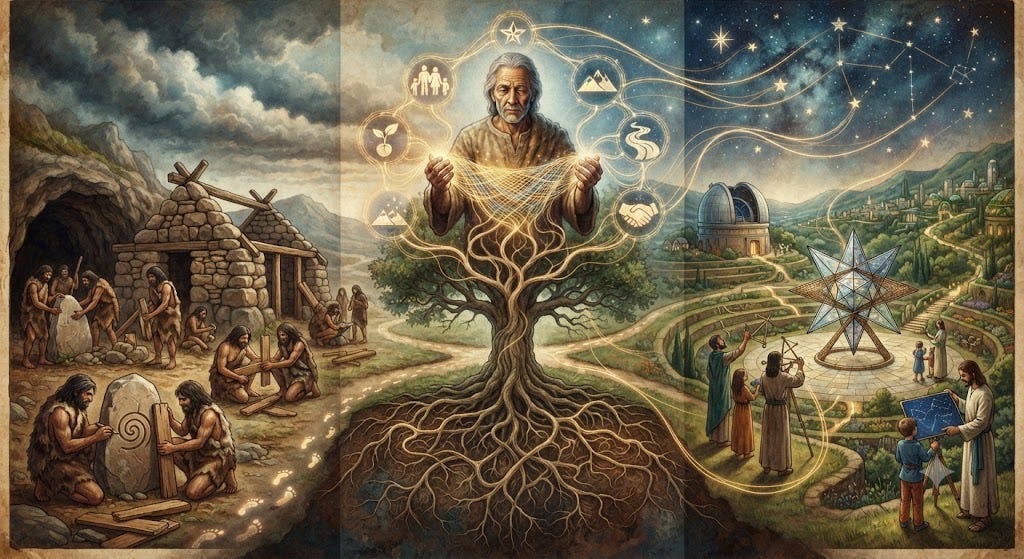
This focus on direction is better captured by the Latin word vitae. Meaning life, vitae captures the inherent movement quality that life embodies. To be absent of vitae is to be absent of life, of movement, i.e., to be dead. This is why arbor vitae, or “tree of life,” is such a beautiful metaphor for the interconnectivity of biological evolution. It is the movement of biological processes, manifesting in the variety of species' development, as each seeks, through various means, to grasp the ongoing need to perpetuate itself.
Vitae is closely connected to the Greek physis, or nature, from which we also get the term psyche or soul, though an astute observer will also note the etymology of psyche being foundational to psychology. More on that in a moment.
While it is standard since Descartes, and to some degree earlier, to differentiate nature and soul as metaphysical opposites or as pertaining to different substances, i.e., the natural and the supernatural, historically the separation was not so clean. (The following is taken from Cornford’s “From Religion to Philosophy”). Anaximander, one of the great thinkers of the Milesians and associated with pre-Socratic philosophy, speculated on nature, but modern thinkers would not find much to compare it to easily, despite using the same word. The Milesians were known for the phrase “the All is alive” as a way to declare that the universe has a “soul” in it. Again, despite its use, “soul” is not meant to convey the same meaning people today often use it for, as it now carries so much reflective baggage of post-Enlightenment thinking. By “soul,” what was meant was more simply to be alive, to move, as in nature is self-moving and therefore alive. This is why there is so much overlap in the use of the term vitae, as the Greeks sought to capture life as an animating principle, not simply to refer to it in the reductionist and yet still very useful way as “matter” in the later Newtonian sense.
Now we return to what it means to be human, as we reflect on our physis and the vitae of our inevitable movement as living creatures. We are possessed of an animating principle where we are not passive creatures but meaning-making conscious manifestations of nature’s variability. To paraphrase Carl Sagan: we are the universe experiencing itself.
Demystifying the Spiritual
To be a meaning-making creature does not require a well-considered and academically rigorous ideological structure. At its most basic level, meaning-making is simply the connective tissue between consciousness and ongoing activity, between the individual and the interconnected variables that make up our constantly evolving context that we find ourselves embedded within. In my work with others, and as a philosophic principle for myself, this is boiled down to how Values are supported in action. As previously stated, it is not so much whether any of us are moving, but in what direction we are doing so.
As biological creatures, we are always constrained by the limits of our resources, and the need to use them in efficient ways. The surplus of neurons that contribute to our conscious lives provides us with a capacity to imagine futures less restrained by mere instinct. This provides a means of both contemplating and planning for an expanding number of possibilities, though this also is a double-edged sword for sowing discord in ourselves and with others as we then act on that imagined future as if it were in the present.
This capacity for imagining futures, of predictively processing possibilities, is what sets us apart within the animal kingdom. We do so through beliefs or psychological constructs, mental associations that are contextually determined to guide our activity within social interactions, connecting us with the ever-collapsing future that we call the present. It is impossible to contain the totality of nature’s variables in our brains, and therefore this biological constraint or limitation means we are forever creating constructs that serve our human purposes. We cannot stop ourselves from always picking and choosing parts of reality to fit what is useful in reaching outcomes we believe are helpful. This isn’t something we remove ourselves from. At best, through reflection, dialogue, and psychological tools like ideologies or worldviews, we develop better ways of funneling the immensity of natural reality into increasingly more productive and ethical ways of living, but we are none of us able to remove ourselves from our embodied nature.
In this light, the usage of spirituality can be simply a recognition of our vitae, our animating principle. It is the acknowledgment that we are not passive recipients of nature’s information, but active co-creators of meaning. This does not require the additional complication of a supernatural, as what we are does not require anything more than the natural for the manifestation of meaning, the development of purpose, and the active involvement in community-building.
The aversion many have within secular communities to the use of spirituality is a legitimate hangover from the limitations and destructive qualities that dogma placed on it. Thankfully, we are not beholden to those former constraints. Neither you nor I must give up the notion of community despite previous dogmatic assertions to “not forsake the assembly,” any more than any of us need give up contemplations of ethics despite previous authoritarian demands to adhere to rigid hierarchies.
What binds us all together in this human endeavor is a bone-deep need to connect our actions to a meaningful structure beyond our immediate selves, to identify how what we do in the present connects us to our imagined futures. None of us are removed from this need, and despite an ongoing cognitive illusion regarding our capacity to transcend our natural world, our brains are as much a part of it as our stomachs and spleens.
Rather than running away from the use of the term “spiritual” as a stand-in for directed purpose, we can use it, like any other verbal tool, to direct our attention to the process we are constantly engaged in: meaning-making. And if you still don’t like the term, that’s ok too. Use another. That’s the beauty of life; it isn’t reduced to one form.
Follow me on Threads or Instagram for more psychology, humor, and photography.
Schedule a Consultation
Reach out to schedule a mental health session regarding issues related to identity and decision-making, emotional regulation, difficulties in relationships, religious trauma, developing meaning/purpose, and the struggles of communication.
How You Can Support the Newsletter
This post was free to read for all. If you like what I’m doing with Humanity’s Values and want to support my work, there are several ways to do so.
Like and Restack: Click the buttons at the top or bottom of the page to boost the post’s visibility on Substack.
Share: Send the post to friends or share it on social media.
Dialogue: Expand the space for dialogue by engaging with others on the topics discussed here and help build the community.
Upgrade to Paid: A paid subscription gets you:
Full access to all new posts and the archive
Full access to all online classes
Full access to weekly presentations on various topics of psychology
Promotional discount on coaching/consultation services
The ability to post comments and engage in chat with the growing Humanity’s Values community
If you could do any of the above, I’d be very grateful. Readers like you help keep this newsletter going and growing.
Thanks!
David