

With every technological advance, there seems to be a not-small number of people who lament what it’s doing to our humanity, and make all manner of declarations to highlight what pieces of ourselves we’re leaving behind. In a few conversational threads on Threads (good marketing name that is), I’ve encountered various forms of how AI is “doing your thinking for you” or “don’t delegate your thinking to an AI.” A great many assumptions underlie these statements, not least the tacit one that AI possesses an agentic consciousness, but also how a thought or series of thoughts somehow become separated from you when using a tool.
The lament is also interesting due to the creeping advance of tech. Thing is, if you’ve ever used spell-check, asked a program to rewrite a sentence or paragraph for you, used Grammarly and other iterations of editing software, or used any amount of other editing software on photos to video, you’ve already “delegated” some of your thinking/activity. Now, before there are screams of how different all of those things are, let’s consider just how we’re delineating those differences.
Is it a matter of degree? At what point can you designate the dividing line between the use of a tool and “delegation”? When you open the program? Ask it a question? Is it just checking spelling, or does grammar cross the line? If you can see yourself writing the final realized statement, did you simply skip the line, so to speak? Perhaps with some humility, are you now performatively projecting that you’d have written it eventually anyway?
Is it a matter of intent? Are you attempting to imitate what you’re not able to do individually? Is the issue one of using a “cheat” to avoid the work or expenditure of resources elsewhere?
I will note that not a single one of the first set of questions, if you were to remove AI and put in a direct human being into the equation, would be answered as a negative. People have little problem engaging in conversations where there’s a breathing person in front of them, and taking advantage of the ubiquity of different perspectives to develop one’s own thinking. Yet, when it comes to an impersonal tool, somehow we’re losing ourselves.
Delegate your thinking? Are college and trade schools, attended in order to learn things you don’t know and can’t do individually, suddenly bad? What about studying in general? In a very real way, we’re piggybacking off the work of others to expand our perspective and understanding of one or another aspect of reality.
The second set of questions likely delves deeper into the underlying concern (reminds me of how often people are asked one question and often are simply answering a different more basic one, thank you Kahneman), which is identifying actions associated with cheating or outcomes that are somehow “unearned.” Yes, there’s a very real concern about how AI has generally been trained without compensating the thinkers and artists for the work that, at least initially, AI was trained on. That’s a different concern than I’m focused on here, though I’ve yet to hear from anyone how, now that it’s done, such compensation is at all capable of being enumerated.
The focus here is more on the problem of “delegation.” I touched on this and other points in the previous article, but wanted to drill down a little further about the nature of self, in particular the notion that self is somehow singular and being obscured or denied by the use of technology.

The Robot Takeover
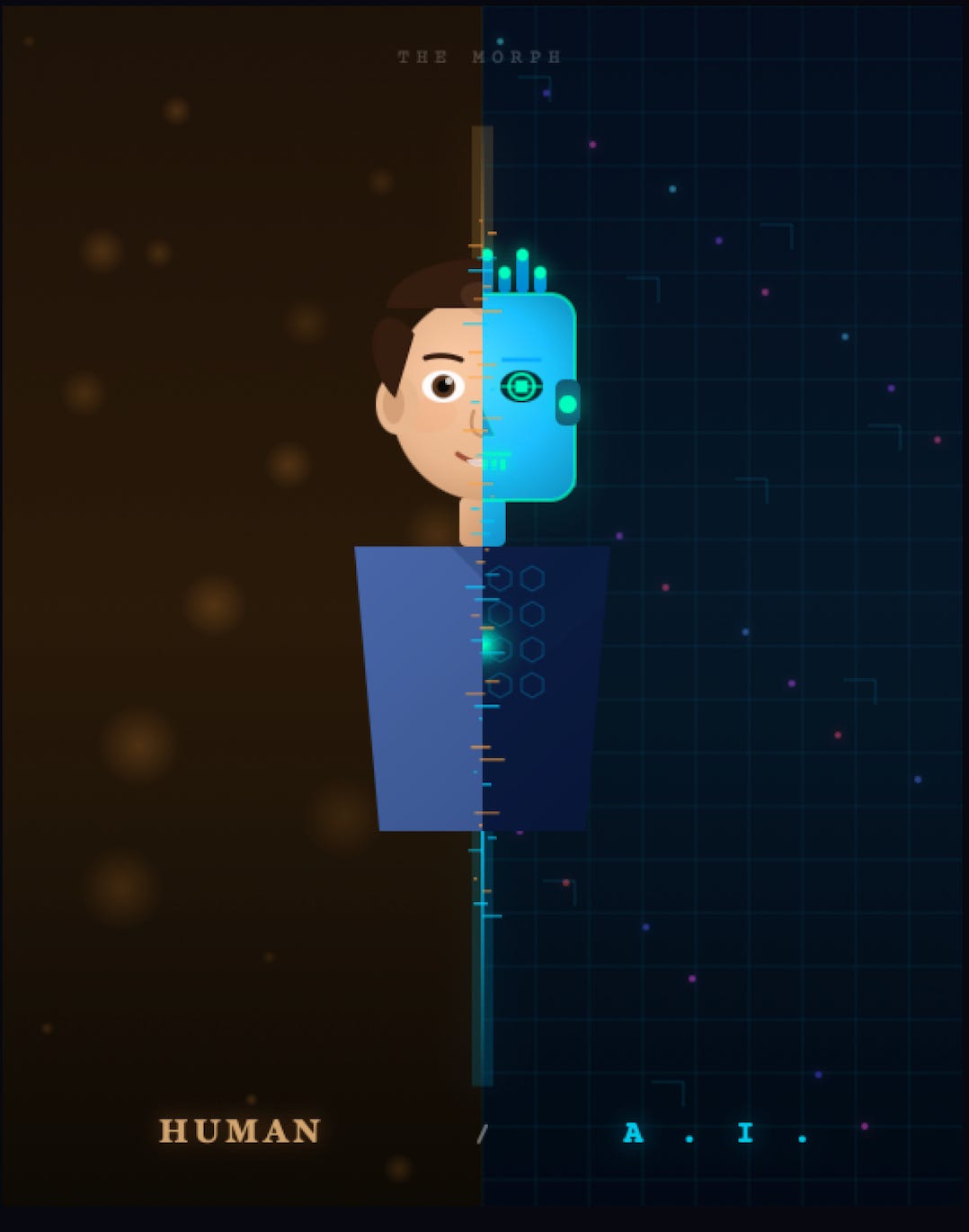
In the final scene of the movie “The Black Hole” released by Disney (I know, it shocks me too) in 1979, also the year I was born, and I’m sure there’s no coincidence, the villain, Dr. Reinhardt, seems to morph together with his robot creation as a testament to his will to live, yet trapped forever within an inhuman experience. Despite being at once utterly bizarre and truly disturbing to this young mind when I first saw the movie, I find that it represents a great deal of what people have in mind when they lament the use of AI in our lives.
There’s a visceral antipathy to the removal of one’s own flesh, as there rightly should be! Replacing it with a metallic substrate is the stuff of horror movies, or, if you’re looking to scar a generation of children, in a Superman movie.
Seriously, who thought kids needed to see that?
Regardless, the horror is real, and anything that bumps up against this removal of the flesh, in part or in whole, is going to have a deep emotional impact. A couple years ago, in an article from Psychology Today, The Illusion of the Modern Self, the author touched on issues related to the redefining of our selves through photo enhancements that, in comparison to what can be done now, seem utterly quaint.
The rise of platforms that can "redefine" our appearance based on existing photographs and transmute our visual self into an array of synthetic identities has ushered in a new existential predicament. This is not mere aesthetic play; this is an engineered mirage, an orchestrated fiction that supplants our empirical reality.
The entirety of this “problem” is the assumption that there’s a singular authentic self that must be kept sacred. “Synthetic identities” not only ignores that identity itself is a co-creative expressive label to show solidarity with an evolving social group, but it also ignores that there must be a person doing the synthesizing. Further, the “mere” in front of “aesthetic” doesn’t really get away from the glaring assumptions, as when do any of the things people have done throughout human history to change their appearance go from “mere” to “existential”? When the first person moved on from fig leaves to animal hides, did someone wonder who they were anymore? When hair and makeup styling went from looking “presentable” (a contextually-dependent word if I’ve ever heard one), to an artistic expression like at the Met Gala, was that an existential bridge too far? I mean, perhaps that’s a bad example, but still.
At no point in human history have we not sought to find new ways of personal expression, and it is through the various iterations of technological development that we have done so. Suddenly I’ve got clothing commercials in my head expressing variations on how the outfits make the person and not the reverse. We even use the metaphorical phrase “a new hat” or “the outfit doesn’t fit you” as an expression of the aesthetic being tied to identity.
But there’s just something scary about AI that goes beyond clothes, makeup, surgery, and implants.
We're buying into an ontological shift—a newly crafted existence made palpable by technology. It is akin to an AI-authored Rorschach Test where the inkblots are replaced by pixels, and the interpretation doesn't disclose your psyche but molds it.
And later…
As we adopt these templates for our offline selves, we may inadvertently contribute to a myth of individuality that is precarious at best. Instead of a spectrum of identities nurtured by authentic experiences and organic development, we are nudged toward ready-made personas, carefully curated by algorithms that have mapped the zeitgeist down to the last pixel.
Here, I think, is where we get to the meat of the matter, this assumption that there’s something indelibly magical about the individual person. Call it a broader version of the “Noble Savage” stereotype, that absurd attempt at lionizing native populations by effectively portraying them in a child-like way. The broader version paints humanity as some pure vessel of creativity, brought low by the venal influences of technology. It’s a Romantic myth, and it’s little wonder such is expressed loudly today with the elevation of the subjective over any attempt at critical appraisal, when truth is contingent upon belonging to the right group rather than based on the strength of one’s argument.
Your Humanity Isn’t Forgotten
When working with people who have experienced trauma from within religious authoritarian frameworks, one of the most pernicious lies that often becomes very difficult to move beyond, is that their “real” or “authentic” self was tied to the dogma and social group of the believing sect. A way to free oneself from this is to see the underlying lie that supports it: that you’re a singular being for which any deviation makes you deviant. This is fundamentally no different than the declarations being made about AI today.
You haven’t lost your humanity when engaging in new tech, you have instead weighted aspects of it as opposed to others, and by doing so, opened up different avenues of expression. It’s the central point of considering all choices as opportunity costs. The world doesn’t owe you anything. There isn’t some “real you” waiting to be discovered. Every activity shuts down the futures for which a different action would have unveiled. Yes, that can be scary and don’t get me started on the multi-worlds theory of quantum physics, because regardless of if its true, we’re here right now with the threads of our lives being snipped, bounded, and let loose.

Unlike Loki becoming Yggdrasil, the World Tree, we are not at the center of anything, despite the egoistic declarations of centrality that our minds continue to conjure up for us. We are, instead, nodes on a web of biological reality, constantly seeking to extend how we see ourselves and what we may become, through the power of our imagination, centered as it often is, in our technological creations.
Yes, there are threats found in almost any possible thread we pull and follow, but you haven’t at any time left the humanity behind that allows you to weave. Question is: how reflectivey critical are you going to be in the possibilities you do engage in?
Follow me on Threads or Instagram for more psychology, humor, and photography.
Schedule an Appointment
Reach out to schedule a mental health session regarding issues related to religious trauma, meaning/purpose, and the struggles of communication.
How You Can Support the Newsletter
This post was free to read for all. If you like what I’m doing with The Humanity’s Values Newsletter, and want to support my work, there are several ways you can do it.
Like and Restack: Click the buttons at the top or bottom of the page to boost the post’s visibility on Substack.
Share: Send the post to friends or share it on social media.
Upgrade to Paid: A paid subscription gets you:
Full access to all online classes on psychology and religious trauma
Full access to exclusive content such as weekly presentations on various topics of psychology and religion
The ability to post comments and engage in chat with the growing Humanity’s Values Newsletter community
If you could do any of the above, I’d be very grateful. Readers like you help keep this newsletter going and growing.
Thanks!
David