



I’ve worked in medical settings as a case worker and with many clients over the years who have stepped up to help in caregiving for a loved one. There is always a juggling act in navigating the priorities and responsibilities associated with seemingly competing values. When does self-care give way to compassion and family, or vice versa? Is there really that much of a separation between them? I work with clients to recognize that the push/pull of values is less about which value is more important and more about how one is showing up in support of them. The limits being found are not in your level of caring, but in the resources available to implement desired behaviors.
To address some of these concerns, we have a guest post by Harry Cline, touching on strategies for practical self-care when caring for others.
New caregivers—people who have recently started providing regular help to a parent, partner, child, or friend—often discover that love and exhaustion can show up in the same hour. Self-care isn’t a luxury add-on; it’s the maintenance plan that keeps you steady enough to keep showing up.
At a Glance
● Aim for “good enough” caregiving, not perfect caregiving.
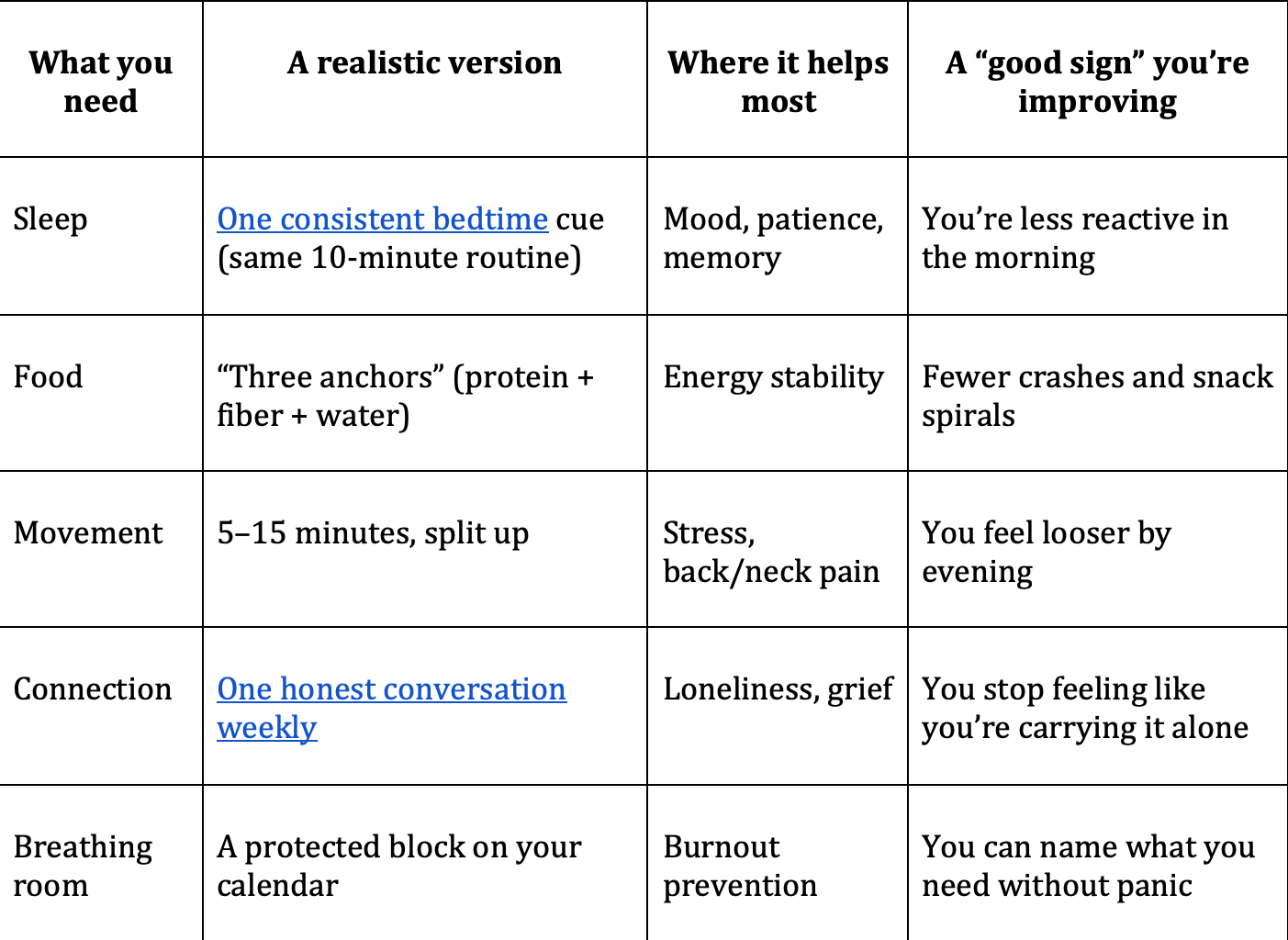
● Protect three basics daily: sleep, food, and a few minutes of movement.
● Use boundaries as tools, not apologies (time limits, task lists, “not today” scripts).
● Ask for help early—before burnout forces the issue.
● Pick three changes this week and treat them like appointments.
A tiny menu of reset moments
When time is tight, self-care has to be modular. Here are quick resets that don’t require a perfect day:
● Drink a full glass of water before you answer the next request.
● Step outside for two minutes and look at something far away (trees, clouds, a brick wall—anything not your phone).
● Do a “kitchen counter stretch” while the microwave runs.
● Send one text that starts with: “Can you cover ___ on Thursday?”
● Put on a song and let your shoulders drop on purpose.
Small doesn’t mean silly. It means doable.
The self-care pieces that matter most
Movement when you’re already stretched thin
Exercise doesn’t have to look like a workout class. If your days are packed with work and caregiving, sneak activity into the cracks: take the stairs instead of the elevator when you can, and use part of your lunch break for a short walk—even ten minutes counts. If walking outside isn’t possible, pace during phone calls, do gentle leg lifts while sitting, or take one loop around the building before you go back in. The goal isn’t athletic glory; it’s keeping your body from locking up under chronic stress.
A caregiver self-care checklist you can start today
Pick a pen. Make it real. Try this for the next 7 days:
● I scheduled one break like an appointment (15–60 minutes).
● I ate one nourishing meal daily (not just snacks).
● I moved my body at least 5 minutes (walk, stairs, stretches).
● I identified one task to delegate and asked a specific person.
● I set one boundary (time limit, “no,” or “I can’t do that today”).
● I wrote down three warning signs of burnout for me (e.g., snapping, headaches, numbness).
● I chose one soothing practice I’ll repeat (music, shower, journaling, meditation, breathing).
If you miss a day, don’t restart the whole plan. Just continue. Consistency beats intensity.
FAQ
How do I stop feeling guilty when I rest?
Remind yourself: rest is part of the care plan. You’re not “taking time away” from caregiving—you’re preventing mistakes, injuries, and emotional blowups that make caregiving harder.
What if my family says I’m not doing enough?
Ask them to choose from a short list of concrete tasks they can take on. If they won’t help, their opinion doesn’t get a vote on your limits.
I don’t have time for therapy—what’s one alternative?
Start with a caregiver support group, brief telehealth options, or a standing weekly check-in with a trusted friend. The key is regular emotional unloading with someone safe.
How do I ask for help without starting drama?
Use specifics and a deadline: “Can you stay with Mom Tuesday from 3–5 so I can run errands?” Specific requests are easier to accept than “I need help.”
One reliable place to get caregiver support ideas
It’s tough to care for yourself when you’re running on empty. For practical, plain-language guidance on protecting your own health while caring for someone else, the CDC’s caregiver self-care page is a solid resource when it comes to navigating that often difficult balancing act between caring for others and remembering to care for yourself.
Conclusion
Caregiving can be meaningful—and still be too much when you try to do it alone, perfectly, all the time. Build self-care out of small parts: a boundary, a meal, a short walk, a real break on the calendar. Choose three changes you can sustain this week and treat them as non-negotiable. Your well-being isn’t separate from caregiving; it’s what makes caregiving possible.